
Blog
Who Is at Fault When a Car Turns Left in Front of a Motorcycle? [2026-2027 Guide]
Short answer: In most cases, the driver who turned left is at fault. California law requires left-turning drivers to yield to oncoming traffic, including motorcycles, until the turn can be made safely. Insurers may still try to blame you for speeding or lane splitting. Even if some fault is put on you, California law still lets you recover. Your share of fault only lowers the amount.
Table of Contents
You were riding straight with the right of way, and a car turned left across your lane. This is one of the most dangerous crashes a rider can have. According to NHTSA’s 2023 motorcycle crash data, 46% of fatal crashes between a motorcycle and another vehicle involved the other vehicle making a left turn.
Below are the questions riders ask us most, in the order they usually come up.
Step 1: At the scene
Should I call the police even if I feel okay?
Yes. A police report records the driver’s version of events while it’s fresh, and it’s often the first document an insurer looks at. Ask the officer how to get a copy.
What evidence should I collect?
As much as you safely can. Take photos of your bike, your gear, the car, the intersection, the skid marks, and the traffic signals. Get the names and phone numbers of any witnesses. If you had a helmet cam or GoPro running, save that footage. Note any businesses or homes nearby that might have cameras.
The driver said “I never saw you.” Does that help them?
No, and it may help you. Drivers have to look for motorcycles before they turn. Saying they never saw you often means they didn’t look carefully enough. Write down exactly what the driver said.
Step 2: The first few days
I feel fine. Do I really need a doctor?
Yes. Adrenaline can hide injuries like concussions and whiplash for days. A medical visit soon after the crash also creates a record that ties your injuries to the crash, which insurers look for.
Should I get my bike fixed right away?
Not yet. The damage to your bike shows how the crash happened, including the angle and force of the impact. Photograph it, and talk to a lawyer before any repairs.
How fast can video evidence disappear?
Within days. Many businesses and traffic systems record over their footage on a short cycle. This is a big reason to act quickly.
Step 3: When the insurance company calls
Should I give the driver’s insurer a recorded statement?
Not before talking to a lawyer. Adjusters often ask questions like “How fast would you say you were going?” Any number you guess can be used to put part of the blame on you.
Should I accept their first offer?
Not until you know the full extent of your injuries. Once you accept a settlement and sign a release, you usually can’t ask for more later, even if your injuries turn out to be worse.
Step 4: Figuring out fault
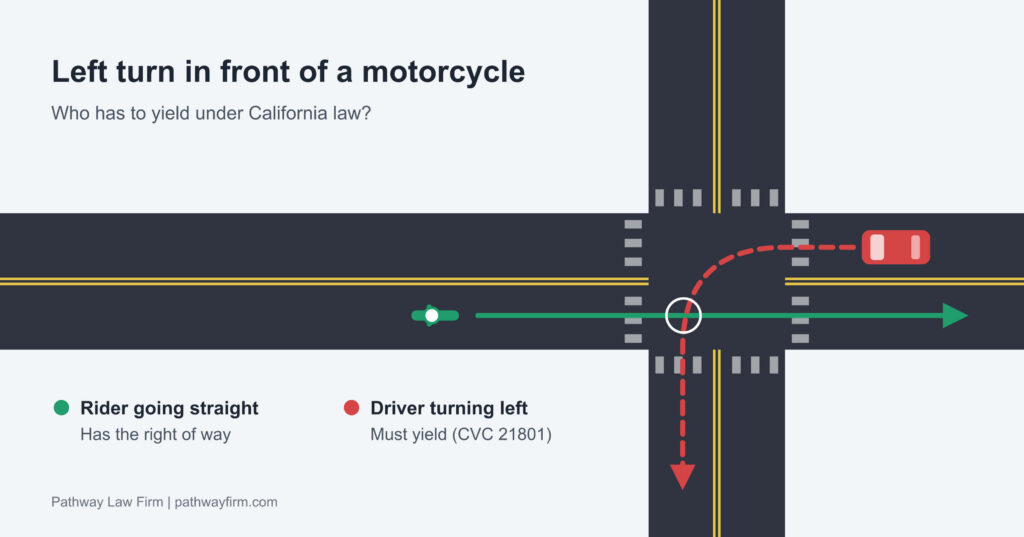
What does California law say about left turns?
The turning driver has to wait. Under California Vehicle Code 21801, a left-turning driver must yield to any oncoming vehicle close enough to be a hazard during the turn, and keep yielding until the turn can be made safely. A gap the driver thinks is big enough isn’t the legal standard. The turn has to actually be safe.
Is the left-turning driver always 100% at fault?
Usually, but not always. Fault can be shared if the rider was going well over the speed limit, ran a red light, or was riding without a headlight. These are the arguments insurers look for.
I was going a little over the limit. Do I lose my case?
No. California uses “pure comparative fault.” Your compensation is reduced by your percentage of fault, but it isn’t wiped out. For example, if your damages are $200,000 and you’re found 20% at fault, you can still recover $160,000.
I was lane splitting. Is that my fault?
Not automatically. Lane splitting is legal in California under Vehicle Code 21658.1. An insurer may argue you did it unsafely, so speed and traffic conditions at the time of the crash matter.
I wasn’t wearing a helmet. Can I still file a claim?
Yes. California requires helmets under Vehicle Code 27803, but riding without one doesn’t bar your claim. It may reduce compensation for head injuries a helmet would have prevented. It doesn’t reduce compensation for broken bones, road rash, or other injuries a helmet wouldn’t have prevented.
What if the driver got a ticket?
It helps, but it isn’t required. A failure-to-yield citation is strong evidence in your favor. Not getting one doesn’t mean you have no case.
Step 5: Getting compensated
Who pays for my injuries?
Usually the left-turning driver’s insurance. Motorcycle injuries are often serious, and the driver’s policy may not be enough to cover them. Your own uninsured/underinsured motorist (UM/UIM) coverage can make up the difference, and it may also apply if the driver had no insurance or drove away.
What can my claim include?
Medical bills (current and future), lost income, repair or replacement of your bike, damaged gear, and pain and suffering.
How long do I have to file?
Generally two years from the crash in California. If a government vehicle or a dangerous public road was involved, a formal claim may be due within six months. Evidence disappears much faster than either deadline.
Hit by a left-turning driver? Talk to Pathway
Insurance companies count on the assumption that riders are reckless. We push back with evidence, including video, accident reconstruction, and witness statements, to show what really happened.
Call 310.414.3898 for a free consultation. There’s no fee unless we win, and if you can’t come to us, we’ll come to you.
Want more guides like this in your Google results? Add Pathway Law Firm as a preferred source.
Your next step
Tell us what happened. We’ll take it from there.
A free, confidential conversation. No obligation, and no fee unless we win.
Call 24/7310.414.3898
Comments